
STAR WARS is Opera
It's not over till the fat lady sings

Star Wars has been controversial for a long time. Even before Disney, when George Lucas released the phantom menace in 1999, he was met with a wave of mixed feedback.
Still, in trying to honestly summarize my thoughts on Star Wars in the modern era, I came to the conclusion that the original six George Lucas movies shine on as iconic pieces of filmmaking history—despite the (admittedly existent) flaws.
This success, in my opinion, is accounted for by the fact that George Lucas understood something that no Disney director seems to. He understood that Star Wars was, and is, more than just a film.
It’s an opera.
The Star Wars story (= the six films in the Skywalker saga) does not owe its impact in the world of storytelling merely to flashy visuals and groundbreaking effects. Rather, people are attracted to the themes.
As many know, Star Wars is the classic hero's journey reimagined. Lucas used a form of mythic storytelling that has fascinated humanity for thousands of years.
But I’ve been thinking that the main reason that Star Wars still works is that it’s an opera. And not a space opera or a soap opera, but an opera opera. This kind of opera.
As wild as it may sound, if you look at the technical elements which make up an opera, Star Wars checks every box—starting with the music. There are several musical components which define an opera: the overture, the recitative, the aria, the chorus, and the ballet. The Star Wars soundtrack has every single one.
Humor me here. Is there any more iconic sound than the Star Wars theme? It’s bombastic, original, and inseparably connected to the brand. But it’s also an overture.
In opera, an overture is meant as a way to introduce the piece. It tells the audience that the show is starting, as well as what the story will be about. It’s even combined with a spoken or sung prologue before the story begins.
In Star Wars, this is exactly what this opening theme does. It’s adventurous, establishing both a musical language and tone for the entire series. You can hear the instruments: the brass, the strings, the woodwinds. Massive sonic potential captured in minutes. And paired with the iconic star wars text crawl…you have an operatic prologue. One that sets up the world and the key elements of the story in a matter of minutes. The story before the story: the overture.
Then, we come to the aria. The aria is a solo piece in an opera. A musical monologue which serves as an opportunity for the character to express their innermost feelings and desires, just to themselves and the audience.
And, in looking at one of the most famous images from the Star Wars films…
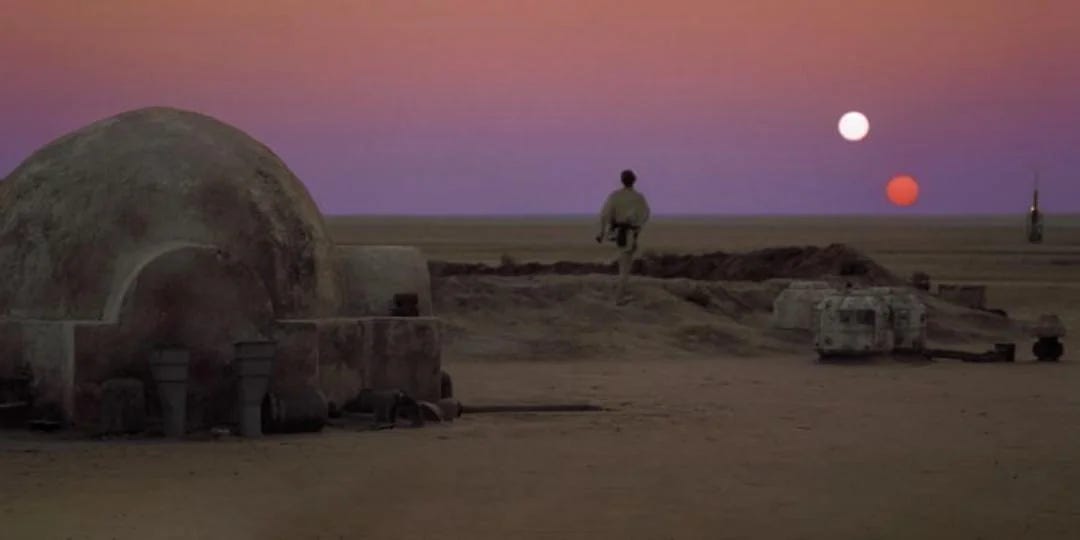
We can see that it’s the perfect example. A manifestation of Luke’s inner yearning for adventure. The sadness of inaction. And the call of the hero. There are, of course, many other examples of scenes like this in Star Wars, whether it be the reveal of Vader’s identity, or even his funeral scene at the end of the original trilogy.
All of these are examples of wordless or near-wordless scenes in Star Wars. Iconic moments brought to life with music alone: auditory manifestations of the true thoughts and feelings of our favorite characters. In other words, these are arias.
Which brings me to the recitative.
The recitative is a musical declamation sung in the rhythm of speech and used to forward the plot of an opera. To put it simply, it’s an opera’s version of a dialogue scene where the characters sing/speak about what’s going on. In these instances, the music becomes an element of the background, highlighting the characters’ dialogue rather than guiding it. Within the medium of film, this could be compared to any dialogue scene. In fact, this operatic method more than likely played a role in how music developed for the screen.
So, in Star Wars, examples of a recitative are almost endless.
There’s the introduction and reveal that Ben Kenobi is the mysterious Obiwan Kenobi for whom Luke has been searching.
Or, in the penultimate scene of Revenge of the Sith, where Anikin, defeated and left burning alive by his former friend and master, screams outs his hatred and rage. It evokes tragedy and failure.
Or even Han Solo and his iconic back-and-forth with the Princess Leia when she tells him, “I love you,” and he wittily replies, “I know.”
And while these scenes are well-written, the writing wouldn’t be nearly as memorable without the music that accompanies it.
Speaking of which…it’s time to discuss the chorus. When it comes to choral music, Star Wars has it down. But among ranks of Williams’ many operatic tracks, I think “Duel of Fates” is probably one of the most recognizable. It’s a piece filled with choral music.
Note here that, in opera, the term “chorus” does not simply describe a large group of singers who join in for major musical numbers. Rather, it refers to the members of the chorus who comment the action at hand and the overall working of the plot.
This is seen all throughout Star Wars. Especially in the fight scenes. Because, in a series titled Star Wars, of course space battles would be key parts of the story. Battles are opportunities to have characters not just clash, but fight over their very ideals and the fate of the galaxy at large. Almost all of these fights are accompanied by choral tracks. That shows us the direct parallel between the “Duel of Fates” scene and the choral scenes of an opera.
In any other movie, this fight between Obi-Wan Kenobi, Qui Gon Jin, and Darth Maul might be just that, a final battle. An epic way to close the third act.
But we have this piece called “Duel of Fates” for a reason. And John Williams’s score brings the epic stakes of this battle to life. If Qui Gon Jin had survived this fight, Anakin would be provided the balanced nuance mentorship he actually needed, avoiding his inevitable demise and transformation into Darth Vader.
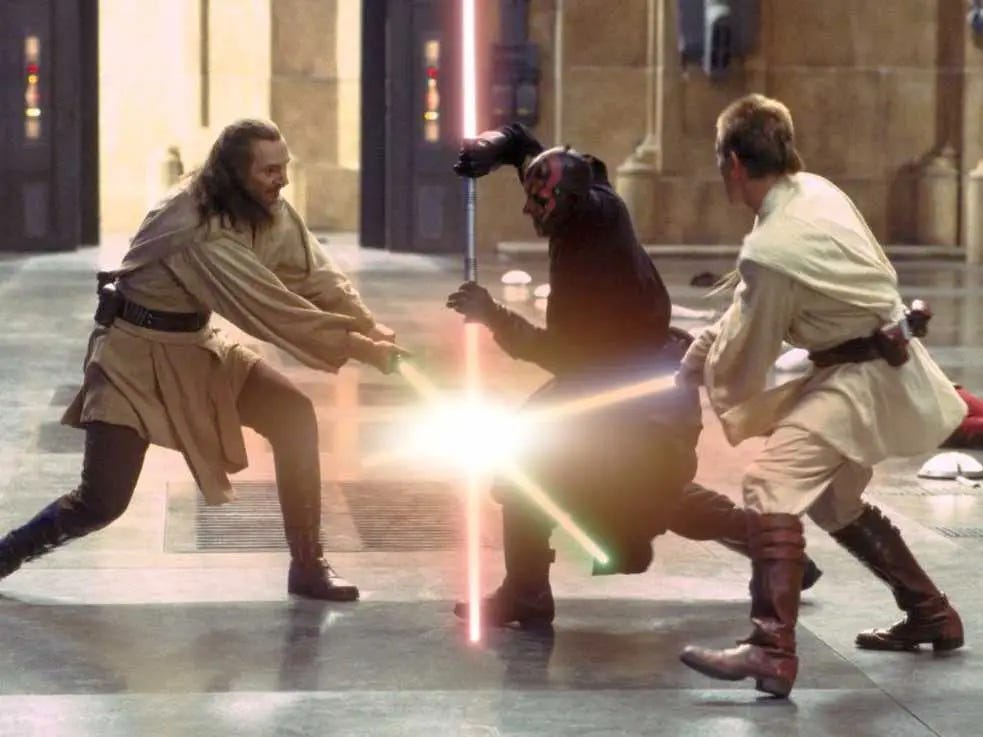
These are the highest stakes imaginable: the outcome of the battle literally impacts the known universe. This track, among many others, acts as a chorus. And the fight itself simultaneously fulfills the final technical musical element of an opera.
The ballet: a story through dance.
But, while the score of Star Wars plays an important role in the films, its similarity to the technical structure of an opera still does not make it one. After all, almost all film music is derived from one of the most famous operatic pieces of all time, Wagner’s Ring Cycle. So, let’s take this concept a little further.
The term space opera began as a slur, a way to dismiss the rising genre of sci-fi as overly dramatic and largely meaningless. Much like the soap operas of the time.
But Star Wars reclaimed this term. Making it not only something positive, but genre-defining. And while my claim is not that Star Wars is simply a space opera, that is an accurate label, because something we can all agree on is that Star Wars is dramatic.
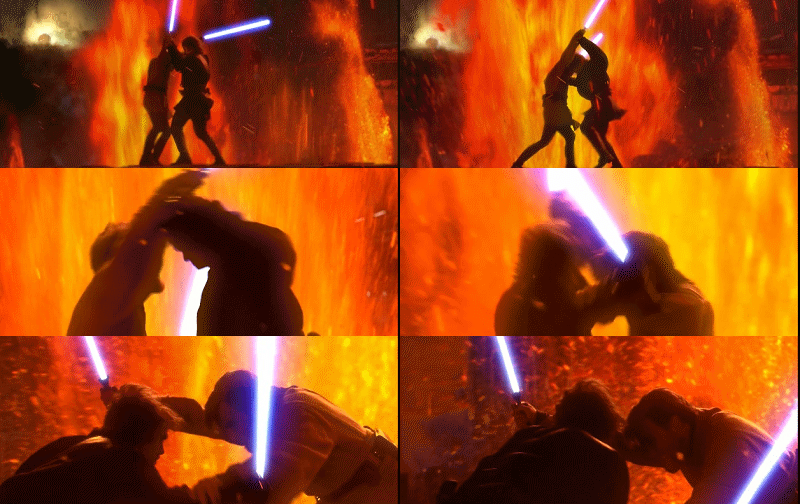
And, sometimes a bit cringy.
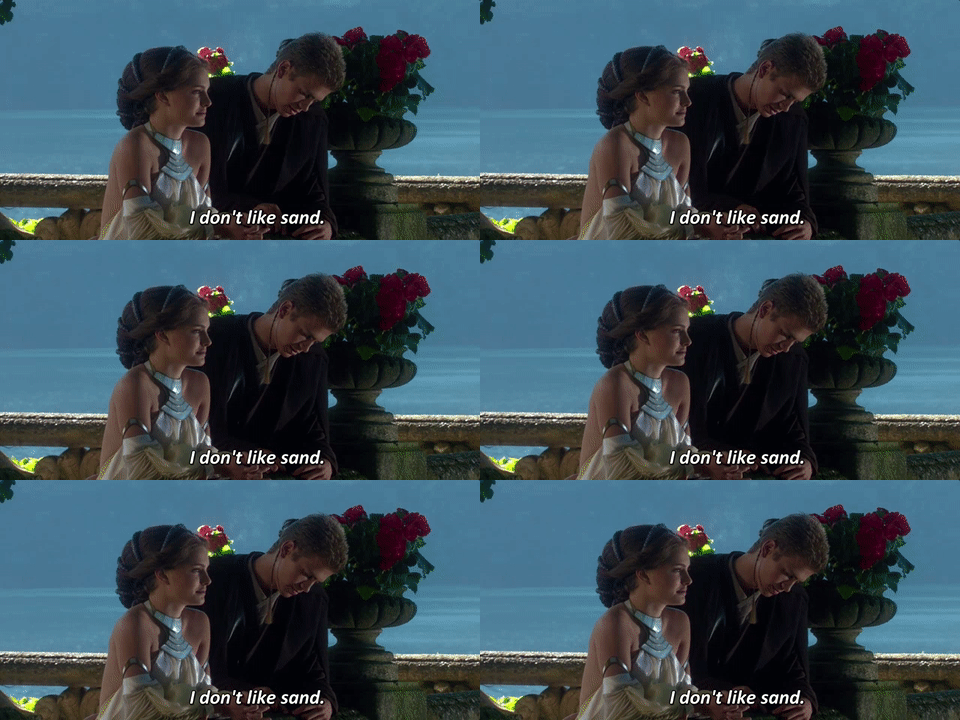
Just like a space opera or soap opera, complete with storylines of secret twins, accidental romance, and forgotten parenthood. Star Wars is dramatic, perhaps even a bit melodramatic sometimes. If I were to remove all the space battles, lightsabers, and timeless themes, you wouldn’t be able to tell the difference between it and a generic soap opera.
Yet this existential drama is key to the story as well. These heightened stakes are what make Star Wars a space opera as well as an actual opera. While it may not be as grounded as other sci-fi projects of its time, or even the current time, somehow these ideas translate. This story has deep emotional resonance, and that can’t be denied.
Which brings me to my final point, the final operatic aspect of Lucas’s Star Wars: its mythic tendencies.
There are many issues with modern takes on the Star Wars universe, but, one of the most overlooked flaws in Disney’s Star Wars is its fundamental lack of substance: the shallow themes which permeate the stories and characters.
Operas have always been known for strong themes that, yes, are dramatic, but also—more importantly—mythic. Operas are meant to capture timeless stories, timeless struggles, and timeless heroes and villains. And more than anything, this is what completes the Star Wars we know and love.
Lucas was not only a student of history, myth, and anthropology, but a navigator, who set out to recapture these for the modern era. And he did.
Star Wars is a tragedy and a hero’s journey in one. It’s a story about failure and redemption. Fate and self-mastery. Good versus evil. And of course, the inner choice we all face between the two.
In this way, it mirrors both myth, and the classical operas and theatre that came after. Lucas sets an example by creating a great story, even if it isn’t a perfect one.
So, the key to understanding Star Wars is opera. If you look at the narrative power and structure of its music, its storytelling components, and its overall themes, the similarities are undeniable.
Humans are more alike than we are different. And, contrary to popular belief, the key to creating truly powerful stories is not covering every possible racial, political, sexual and religious quota.
The key to truly powerful storytelling is rooted in this fact, in our faults and failings. Our love and our loss. And our constant striving for something beyond ourselves: divinity.
And as imperfect as it might be, this is why Star Wars works. And honestly, why it may never work again.
Till next time,
James